

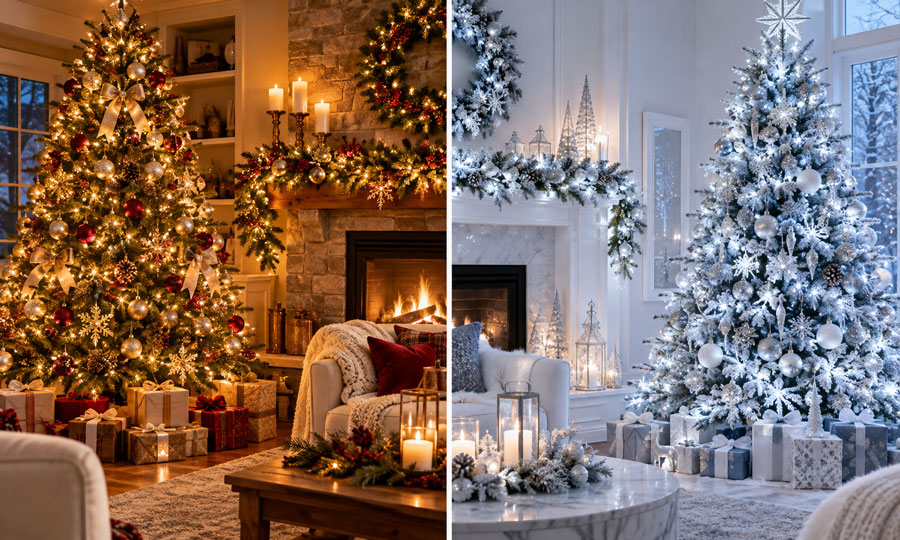
Warm White vs Cool White Christmas Lights at a Glance
When Should You Choose Warm White Christmas Lights?
When Should You Choose Cool White Christmas Lights?
How to Choose the Right White for Your Home
Can You Mix Warm White and Cool White Christmas Lights?
Which Should You Choose If You Are Still Undecided?
FAQs
Choose warm white Christmas lights for a cozy, traditional display, or cool white Christmas lights for a crisp, wintry look. Warm white complements red ribbons, gold ornaments, and natural greenery. Cool white suits silver decorations, blue accents, and icy holiday themes.
The best choice also depends on your home’s exterior and the lighting already around it. A strand that looks attractive on its own may appear unexpectedly yellow or blue beside your porch lights.
When comparing warm white Christmas lights vs cool white, start with the atmosphere you want, check the actual color temperature, and test the lights where you plan to use them.
Warm White vs Cool White Christmas Lights at a Glance
Color temperature describes how warm or cool white light appears. It is measured in kelvins, shown as K. Lower values look warmer and more yellow; higher values look cooler and may have a bluish tint.
For Christmas lights, warm white commonly falls around 2700K–3000K, while cool white often falls around 5000K–6500K. However, product labels vary, and some suppliers use “cool white” for lower temperatures. Always check the numerical specification rather than relying on the color name alone.
| Feature | Warm White Christmas Lights | Cool White Christmas Lights |
|---|---|---|
| Typical appearance | Creamy white with a golden tint | Crisp white, sometimes with an icy blue tint |
| Overall mood | Cozy, nostalgic, welcoming | Fresh, wintry, contemporary |
| Complementary decorations | Red, gold, copper, wood, natural greenery | Silver, blue, glass, white, frosted decorations |
| Common applications | Traditional trees, wreaths, garlands, welcoming entrances | Snowflakes, icicles, contemporary displays |
| Main consideration | Can look more yellow than expected beside cooler lighting | Can feel too stark beside warm household lighting |
These are styling guidelines, not restrictions. A modern house can look beautiful with warm white lights, and a traditional home can carry a cool white winter theme.
When Should You Choose Warm White Christmas Lights?
Warm white is a strong starting point when you want Christmas lighting to feel relaxed and familiar. Its gentle golden appearance works particularly well with traditional holiday colors and natural materials.
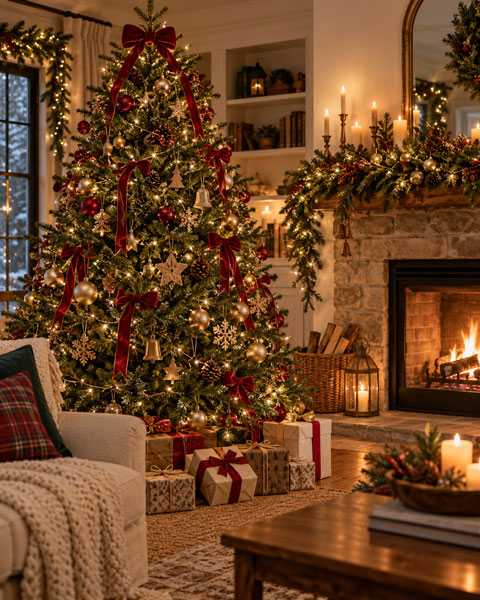
For a Traditional Christmas Tree
Picture a green tree decorated with red ribbons, gold baubles, and wooden ornaments. Warm white lights bring those elements into a cohesive palette without introducing a strong icy contrast.
For this look, keep the tree, nearby garlands, and mantel decorations in a similar shade of white. Matching the light color helps the eye move naturally across the room.
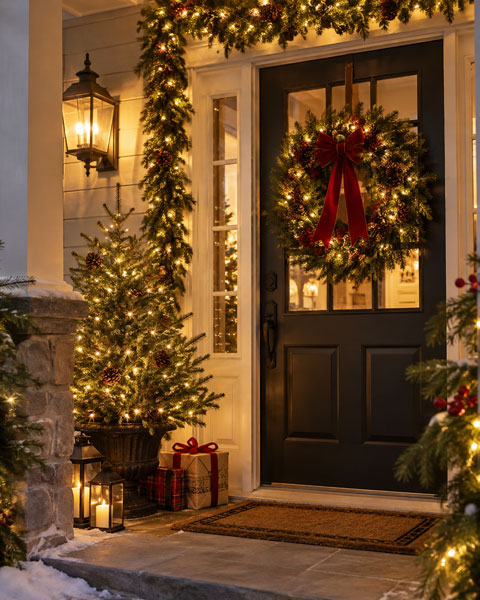
For a Welcoming Front Entrance
Warm white is also a useful choice for a wreath, porch garland, or small tree beside the front door. These decorations are viewed at close range, where the relationship between the Christmas lights and the porch fixture is especially noticeable.
Try switching on your everyday entrance lighting before testing the Christmas lights. If both have a similar warm appearance, the decorations will feel like part of the home.
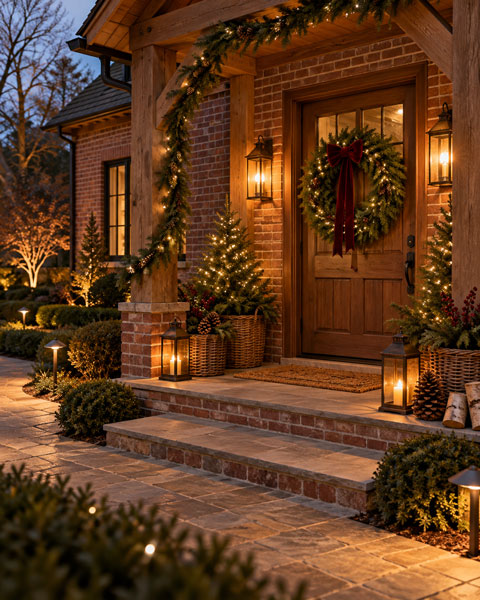
For Brick, Wood, and Natural Textures
Red brick, timber posts, wicker baskets, and pinecones provide a natural setting for warm white lighting. For example, a brick entrance with a green wreath and burgundy ribbon offers a straightforward palette: warm materials, warm decorations, and warm light.
If the display extends into a landscaped yard, the difference between 2700K and 3000K landscape lighting can help you coordinate seasonal lights with the fixtures already illuminating your garden.
When Should You Choose Cool White Christmas Lights?
Cool white suits a display built around snow, frost, silver, and blue. Its cooler appearance supports a winter theme and creates a distinct contrast with warmer indoor lighting.
For an Icy or Snow-Themed Display
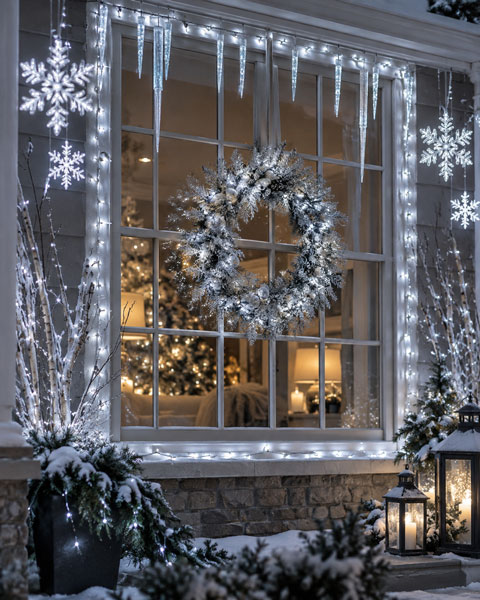
Cool white works naturally with illuminated snowflakes, hanging icicles, and frosted branches. Repeating that tone across these elements gives the display a clear visual theme.
For example, you might frame a front window with cool white lights and place a silver wreath in the center. Keeping the surrounding decorations simple lets the light color establish the mood.
For Silver, Blue, and Glass Decorations
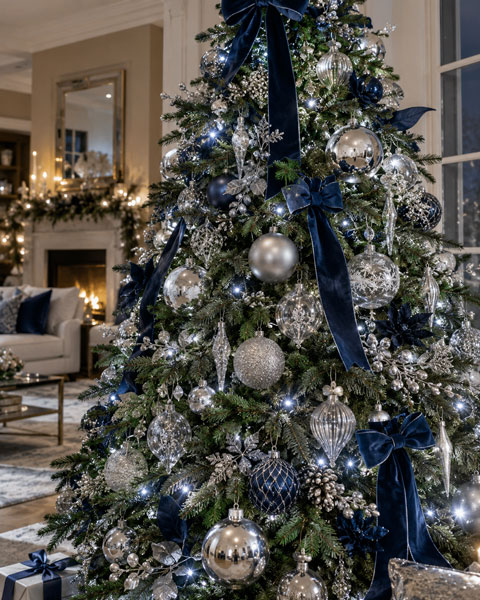
A tree with silver ornaments, blue ribbons, and transparent glass decorations is a good candidate for cool white lighting.
Test a short strand beside your actual ornaments before decorating the entire tree. Reflective finishes can make individual bulbs appear more prominent, so you may prefer a less intense strand or wider spacing.
For a Crisp Architectural Outline
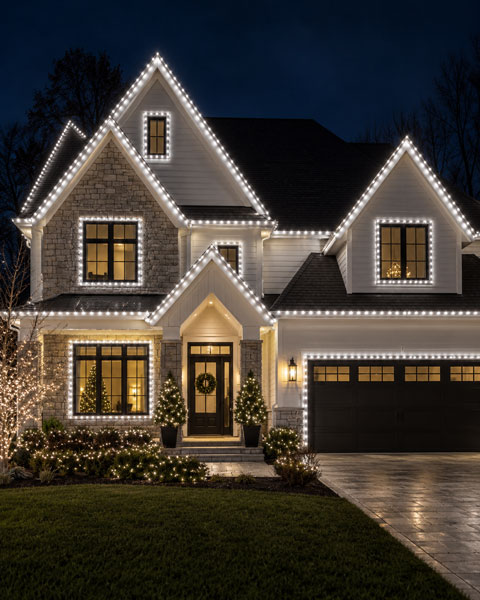
Cool white can suit a display that emphasizes windows, gables, or geometric shapes. Consider it when you want the lighting to read as a clear outline rather than a soft background glow.
Still, judge it against the actual building. Pale siding, gray stone, and metal details do not automatically require cool white. Your preferred atmosphere matters as much as the materials.
How to Choose the Right White for Your Home
1. Decide What You Want People to Notice
Start with one visual priority.
If the focal point is a welcoming entrance with greenery, begin by testing warm white. If it is a large snowflake display or a blue-and-silver tree, begin with cool white.
This makes the choice more manageable than trying to find one color temperature that suits every possible decoration.
2. Compare the Lights with Your Existing Lighting
Look at the whole scene after dark, including porch lights, pathway fixtures, and indoor lights visible through windows.
A warm strand may look noticeably more yellow beside a cool porch light. Equally, cool white Christmas lights may stand out sharply against a warm entryway.
For a unified display, coordinate lights that appear together in the same view. Exact matching is not always possible, but a small sample test will reveal whether the difference feels attractive or distracting.
3. Check Kelvin Values and Product Consistency
Two boxes labeled “warm white” may not produce identical light. Color differences can occur between product ranges and production batches.
For one continuous roofline, tree, or garland, buy matching strands from the same product range whenever possible. Keep the model number and color specification so future replacements are easier to select. Buying the required quantity together can reduce visible variation.
4. Separate Light Color from Light Output
Cool white can look more striking in some settings, but a higher Kelvin number does not automatically mean a light produces more illumination.
Kelvins describe color appearance; lumens describe light output. A warm white product can have the same lumen output as a cool white product. Bulb spacing, lens design, and placement also influence how a display looks.
If your warm white display seems too subtle, compare light output and spacing before changing to a cooler color. If a cool white display feels overwhelming, consider a lower-output product or fewer lights.
5. Test a Small Section After Dark
Before installing the entire display:
- Place a short strand beside the intended decorations.
- Turn on the other lights normally used in that area.
- Check the result from close range and from the usual viewing distance.
- Compare the appearance with your own eyes, rather than relying only on a phone photo.
- Confirm that the product is rated for its intended indoor or outdoor location.
For a roofline, view the sample from the street. For a Christmas tree, view it from the sofa. The right choice should work from the place where you will actually enjoy it.
Can You Mix Warm White and Cool White Christmas Lights?
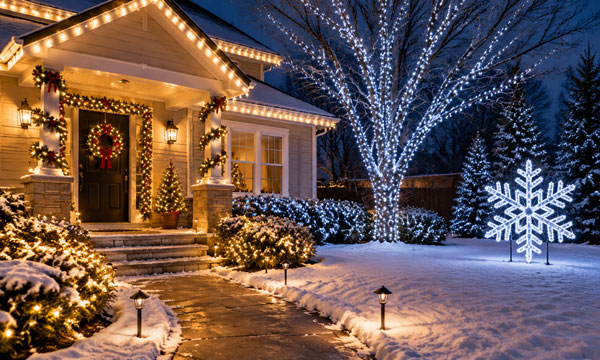
Yes. Mixing can work when the contrast follows a clear design.
An effective approach is to assign each temperature to a separate feature. You might use warm white around the entrance and cool white for a freestanding snowflake decoration farther into the yard.
Avoid accidentally switching between warm and cool strands halfway along one continuous outline. That tends to draw attention to the mismatch rather than the decoration.
For a small porch or a single tree, one consistent white is usually easier to coordinate. For a larger display, separate zones give you more room to introduce contrast.
Which Should You Choose If You Are Still Undecided?
If your goal is a classic Christmas atmosphere, start with a 2700K–3000K warm white sample. If you want an icy, silver-and-blue theme, start with a 5000K–6500K cool white sample.
If neither feels right, consider a neutral white option. Check its Kelvin rating carefully because terms such as “pure white” and “neutral white” are not used consistently across products.
The most useful final check is simple: do the lights complement your decorations, work with the surrounding lighting, and create the atmosphere you intended? Choose the shade that satisfies those three conditions.
FAQs
1. Do Warm White Christmas Lights Use More Electricity Than Cool White?
Not necessarily. Electricity use depends on the actual power draw and operating time, not simply whether the light looks warm or cool.
Two strings that each draw 10 watts use the same amount of electricity when operated for the same duration. Compare the total string wattage rather than the color label or bulb count alone. Understanding what the wattage of a light bulb indicates helps you make that comparison.
2. Do Warm White or Cool White LED Christmas Lights Last Longer?
Neither color temperature alone guarantees a longer lifespan. Product construction, operating conditions, and the durability of wiring and electronic components are more useful considerations.
When assessing how long LED Christmas lights last, distinguish the stated LED life from the service life of the complete string. A long LED rating does not guarantee that every connector or controller will last equally long.
3. Will Dimming Cool White Christmas Lights Turn Them Warm White?
Usually, no. Dimming a fixed-color LED product mainly changes its light output. A warmer appearance during dimming requires a product specifically designed for that behavior.
Color-adjustable lights may offer separate warm and cool settings, but that is a different feature from ordinary dimming. Check that both the string and its controller support the adjustment you want.
4. Does Choosing Warm White Prevent LED Christmas Lights from Flickering?
No. Flicker is related to the power supply and control electronics, rather than the warm or cool color label. Either type can show flicker.
Some LED strings use rectification to reduce the effect. If flicker is a concern, look for a product with clear information about flicker performance and test a sample before installing a large display.
5. Are Clear Christmas Lights the Same as Cool White Lights?
Not always. “Clear” may describe the bulb’s transparent covering rather than its color temperature.
Traditional clear incandescent Christmas lights generally produce warm-looking light. Clear LED bulbs can contain either warm white or cool white LEDs. The distinction becomes easier to understand when you consider incandescent light color temperature: a clear bulb does not necessarily produce an icy white glow. Check the light source and Kelvin specification before buying.
