

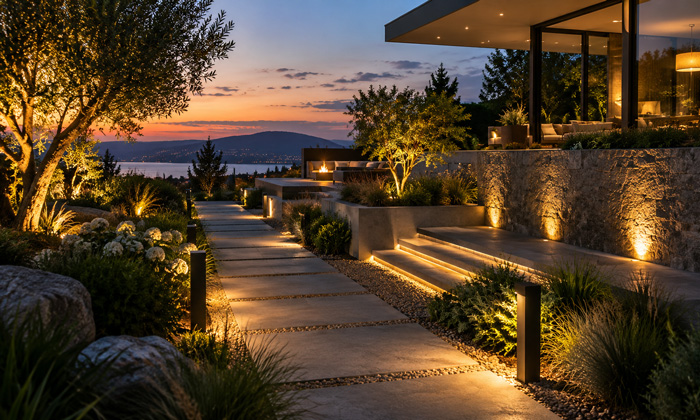
How Lighting Changes the Way You Experience a Garden
Choose Path Lighting That Suits the Setting
Match Wall Lighting to the Surface
Coordinate Color Temperature Across Paths and Walls
Choose Power and Controls Around Everyday Use
Plan for Outdoor Conditions and Maintenance
FAQs
A garden’s layout can become difficult to appreciate after sunset. Paths disappear into planting, walls lose their texture, and the view from the house may end at the nearest window.
Architectural lighting for modern garden paths and walls brings those elements back into view. It helps people navigate, reveals the character of building materials, and creates a more inviting setting for evenings outdoors. Carefully controlled light and shadow give the landscape depth without making every surface equally bright.
The starting point is to consider paths and walls together: the path guides movement, while the wall helps define the space around it.
How Lighting Changes the Way You Experience a Garden
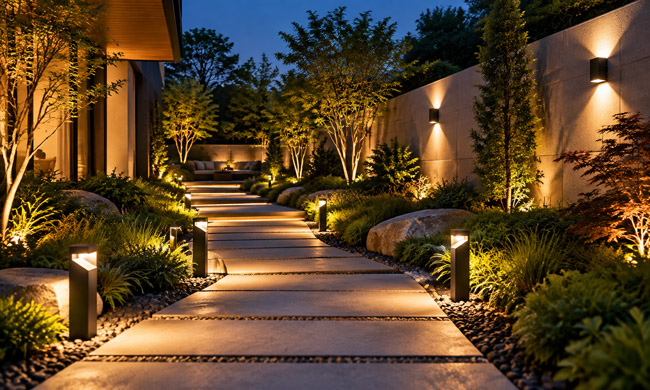
Path lighting establishes a readable route between entrances, gates, terraces, and seating areas. Wall lighting adds a vertical dimension, helping the eye understand the garden beyond the ground immediately ahead.
Together, they create a visual sequence. A softly illuminated walkway can lead toward a seating area, while a wall behind it provides a gentle background. Selected details become points of interest, with darker areas preserving contrast. This approach reflects the design hierarchy of orientation, focal points, and background used in landscape lighting plans.
For a modern garden, that sequence can reinforce the existing architecture. A straight route might feel calm and orderly; a curved path can reveal the garden gradually. The lighting should support the experience the layout already suggests.
Choose Path Lighting That Suits the Setting
There are several ways to illuminate a garden path, and visible posts are only one option.
| Lighting approach | Suitable setting | Main consideration |
|---|---|---|
| Shielded path lights | Paths beside planting beds or gravel borders | Direct the light onto the walking surface |
| Recessed marker lights | Minimalist paving and narrow routes | Check glare and whether they provide enough useful ground illumination |
| Downlighting from a structure or suitable tree | Paths beneath pergolas or mature canopies | Aim carefully to avoid bright spots and distracting shadows |
These approaches can also be combined where the setting changes along a route. EcoTek’s path lighting guide distinguishes the same three broad options and stresses matching the method to the landscape.
Begin placement at the points that need clear visibility: entrances, bends, junctions, and changes in level. Then assess the connecting stretches. Aim downward, shield the source, and avoid abrupt bright and dark patches along the walking route.
There is no single spacing measurement that suits every fixture. Mounting height, beam distribution, path width, and nearby surfaces all affect the result. Use the chosen fixture’s photometric information and an after-dark trial to refine the layout.
For example, a path beside a low wall may need fewer freestanding fixtures if concealed wall lights already illuminate the paving. Checking the combined effect before adding more fittings can keep the composition visually simple.
Match Wall Lighting to the Surface
Wall Washing
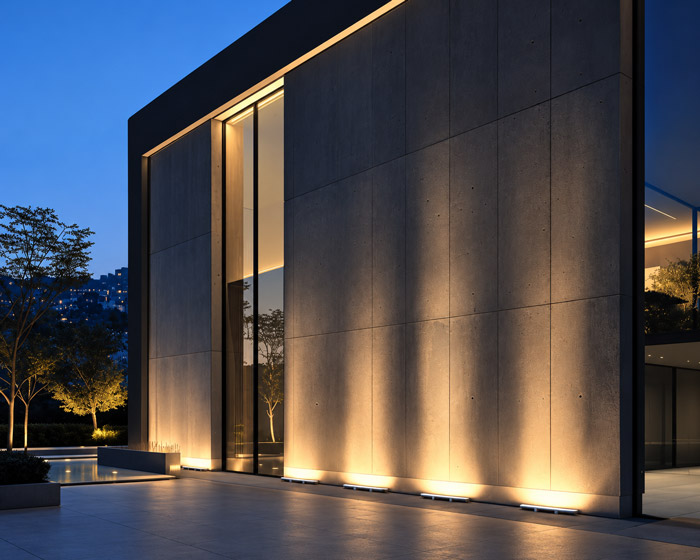
Wall washing spreads light broadly across a vertical surface. It suits a smooth wall when the aim is an even, calm background.
A properly selected wall washer light fixture distributes light over a wider area than a focused spotlight. Its position, beam, and distance from the wall affect how evenly that surface appears.
Wall Grazing
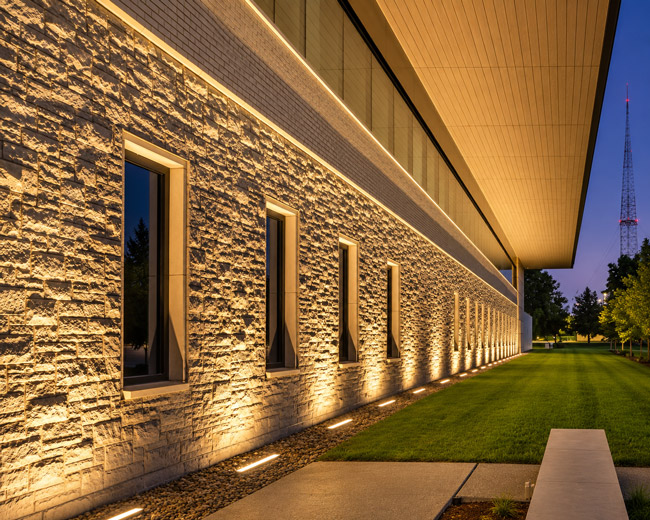
Wall grazing places light close to a textured surface so that raised details cast shadows. It can emphasize the relief of stone or brick.
Washing and grazing therefore produce different results: one creates broad coverage, while the other emphasizes texture.
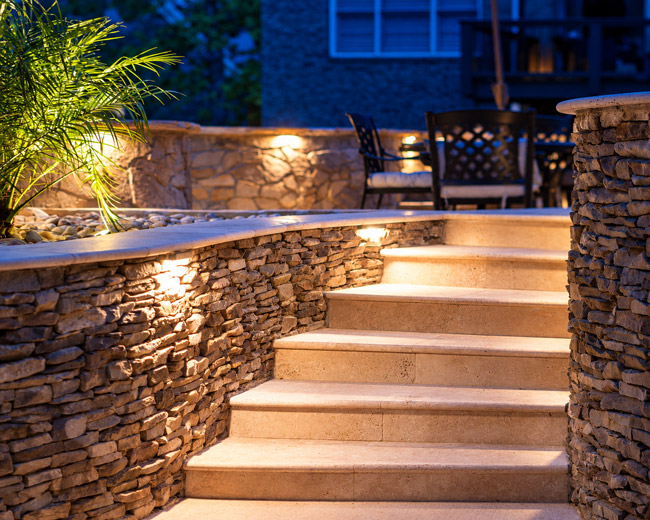
Integrated Hardscape Lighting
Integrated hardscape lighting offers another option. Fixtures built into walls, steps, or seating can provide concealed illumination close to where people move or gather. This can help connect the wall visually with the adjacent route.
Before choosing an effect, decide what deserves attention. A beautifully textured wall may justify grazing. A plain wall behind ornamental planting may work better as a softly washed background. Treating every wall as a feature can make the garden feel visually crowded.
Coordinate Color Temperature Across Paths and Walls
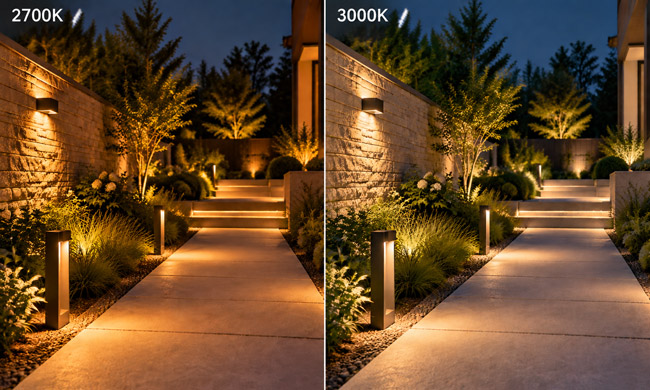
Color temperature influences how paving, masonry, and planting appear together. For a residential garden, 2700K and 3000K are useful warm-white options to compare.
In a 2700K vs 3000K landscape lighting comparison, 2700K has a warmer, more golden appearance, while 3000K looks slightly crisper. Neither is automatically the better choice for modern architecture; the surrounding materials and desired atmosphere matter.
Try both against an actual section of paving and wall. Look from the path, the seating area, and inside the house. A finish that looks appealing beside one material may feel less harmonious across the full scene.
Keeping the principal path and wall lighting at a consistent color temperature can help unify the garden.
Choose Power and Controls Around Everyday Use
The right power system depends on how reliably the lights need to operate and where they will be installed.
When comparing solar vs low-voltage outdoor lighting, consider sunlight availability, required operating hours, and installation access. Solar fixtures can simplify installation where wiring is difficult, but their runtime depends on charging conditions and battery performance. Wired low-voltage lighting provides operation independent of daily sunshine and suits coordinated lighting across frequently used routes and walls.
Separate control of functional and decorative lighting adds flexibility. Path lighting can support arrivals, while wall accents create an evening setting. Scheduled scenes and compatible dimming allow the garden’s appearance to change as its use changes.
For instance, an evening scene could illuminate the route to a terrace and gently highlight its surrounding wall. Later, decorative lighting could switch off while the necessary access lighting remains available.
Plan for Outdoor Conditions and Maintenance
Fixture selection should account for moisture exposure, impact, corrosion, and maintenance access. Recessed fittings also require attention to their installation conditions and drainage.
Match the product’s environmental and mechanical ratings to its actual location. A wall-mounted fitting, a fixture in a planting bed, and a fitting recessed into paving face different demands. Plan access to connections and serviceable components before completing the hardscape.
Think about the garden’s future appearance, too. Could mature planting obscure a path light? Will a fixture become difficult to reach behind a hedge? Is a concealed fitting still accessible for replacement? Resolving these questions during planning helps preserve the intended design.
FAQs
1. How Much Does Architectural Lighting for Garden Paths and Walls Cost?
The cost depends on fixture quantity, product quality, cable distances, site access, and installation complexity. A short pathway with accessible planting beds generally requires less work than recessed lighting integrated into existing masonry.
When comparing landscape lighting installation costs, request an itemized quote covering fixtures, power supplies, wiring, labor, and any surface repairs. A useful estimate should describe the finished lighting effect as well as the equipment included.
2. Are LED Garden Path and Wall Lights Expensive to Run?
Calculate operating costs from the system’s electricity consumption and your local tariff:
Monthly cost = input watts ÷ 1,000 × operating hours per day × days per month × electricity price per kWh.
For example, a system drawing 60 watts for five hours each evening uses approximately 9 kWh over 30 days. At an illustrative rate of $0.20 per kWh, that equals $1.80 per month. Use total input consumption, including power-supply losses and controls, rather than simply adding the advertised fixture wattages.
3. Can Architectural Lighting Be Added to an Existing Garden Without Rebuilding It?
Yes, lighting can often be retrofitted into an established landscape. Installers can assess existing planting beds, accessible cable routes, and suitable mounting surfaces to limit disturbance.
However, lights recessed into finished paving or masonry may require localized cutting, lifting, or repairs. Ask the installer to identify these areas before work begins and explain whether existing wiring and power supplies can support the proposed additions. The amount of disruption depends on the site and fixture design.
4. Why Are the Lights at the End of My Garden Path Dimmer?
In a wired low-voltage system, voltage drop is one possible cause, particularly along long cable runs. Cable size, connected load, and connection condition can affect the voltage reaching each fixture.
An installer should measure voltage under load and compare it with the fixture manufacturer’s operating range before recommending changes. Appropriate landscape lighting wire sizing helps address distribution problems; installing brighter lamps alone may leave the underlying issue unresolved.
5. Can Garden Path and Wall Lighting Affect Wildlife?
Yes. Artificial light at night can disturb wildlife behavior, so lighting near hedges, ponds, and other habitats needs particular care.
Understanding the impact of garden lights on plants and animals helps identify areas that should remain dark. Keep illumination confined to necessary walking surfaces and architectural features, preserve unlit habitat connections, and minimize unnecessary operating hours. No lighting color is universally harmless to every species; limiting exposure remains important.
